
Hands-On Geology: Exploring the 3 Types of Rocks with Chocolate
One of the most powerful ways children learn science is by doing it!
At Ohmapi, we bring earth science to life with engaging the senses. Rather than starting with abstract diagrams or memorization, we begin with story, movement, and hands-on exploration so children can build real understanding through experience.
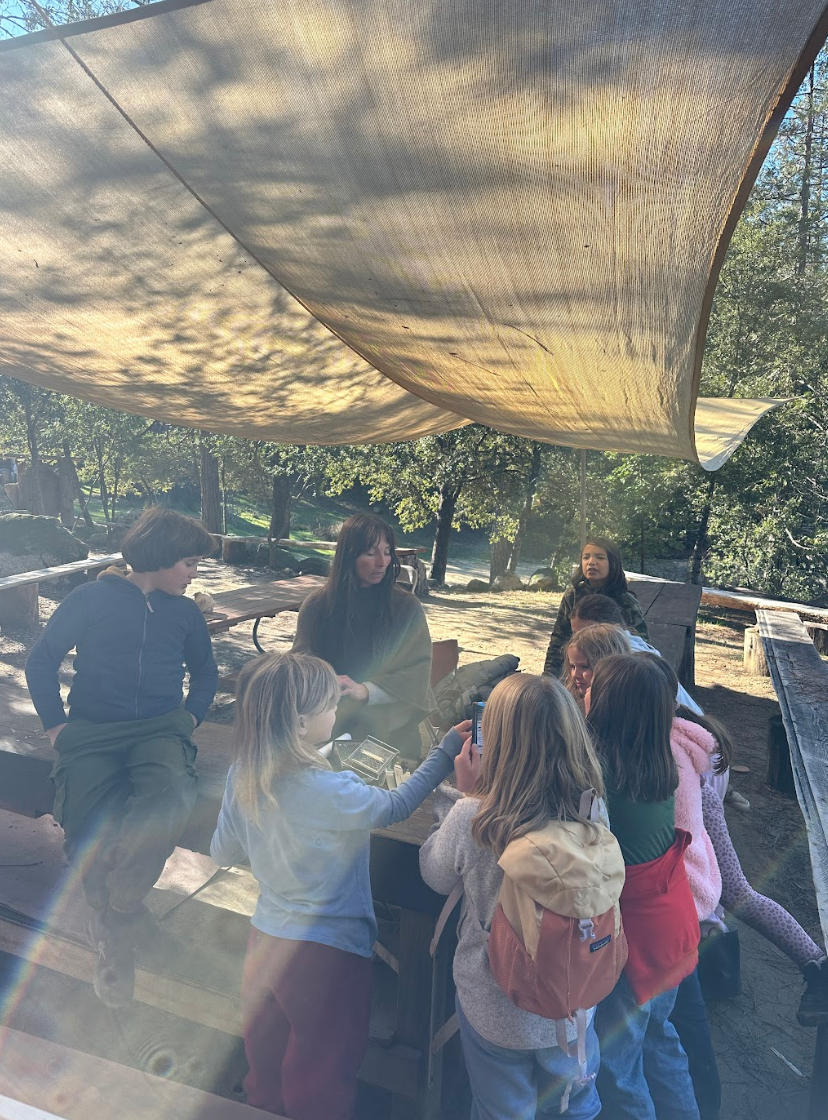
This past week, our students explored the three types of rocks through story and then by immersive, sensory-rich activities, including a favorite material: chocolate.
Learning Through Story: How Rocks Are Born
Our geology block began with Mother Earth and the Three Kinds of Rock, a mythical tale that introduces how rocks are formed over time through fire, water, pressure, and life itself.
Through story, children learned:
The minerals that make up granite
How rocks can form from fire, water, plants, and animals
That rocks change over time through natural cycles
Story creates context, and context helps scientific concepts take root.
Mother Earth and Vulcan
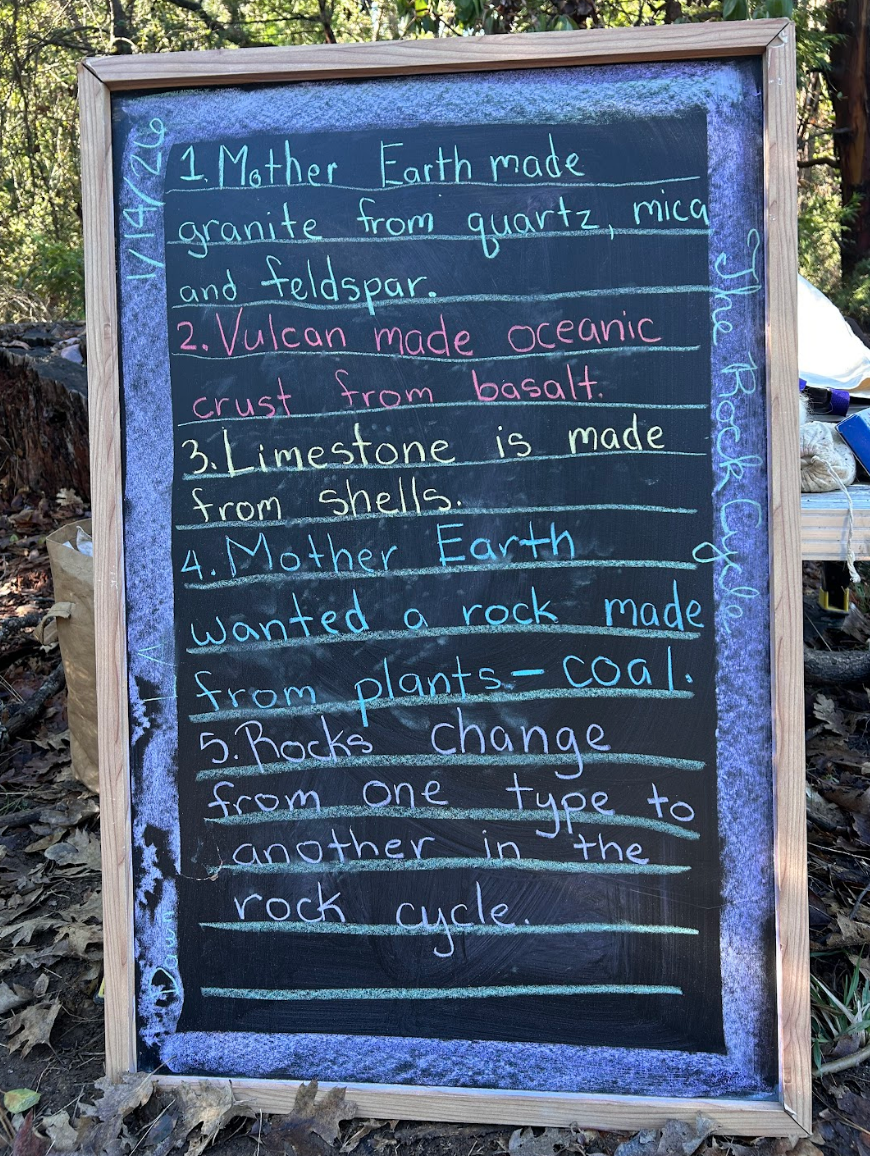
Once upon a time, a long time ago, when the world was new, it was bubbling with lava and toxic gases. Mother Earth looked out upon this molten land and knew that it had the potential. Lots of potential. She knew that it could one day be a land filled with beauty and life. She thought that perhaps the best place to start in helping Earth reach its potential would be to make part of the Earth solid. That would entail her to make ROCKS!. This molten earth was filled with the ingredients to make rocks: elements like Calcium, Iron, Silicon but everything was still molten and all those ingredients had not yet combined nor cooled enough to form rocks. Mother Earth was a very thoughtful type. She wanted to make her rocks with intention. Mother Earth decided to call upon some helpers. She called proton, neutron, and electron. She asked proton, neutron, and electron to bring to her their gifts in the form of minerals so that the first rocks could be made.
The neutron was blessed with wisdom. And so Neutron brought to Mother Earth a mineral that was as clear as water. It was transparent. Neutron said, “This is the mineral which is like the light of wisdom. Wise thoughts are like this shining crystal.”
Next came Electron. Electron was blessed with strength and power. In his right hand he carried a black mineral, and in his left he carried a white mineral. Electron said, “These two minerals, black and white, are the minerals of strength. They will add to the wisdom energy. Energy and strength to perform great deeds.”
Lastly came Proton, who was blessed with warmth and love. Proton brought red and green minerals. Proton said, “In these minerals is the warmth of hearts. These minerals can have many forms and will serve in many ways.”
Mother Earth was pleased with these gifts and thought they would guide the Earth well. She mixed them together to create her first rock, granite. The clear mineral is quartz, giving the gift of light. The black and white minerals are mica, providing strength. And the third mineral is feldspar, which is most often pink or white but can also be green, which gives the gift of warmth. Granite: quartz, mica, and feldspar; wisdom, strength, and warmth.
Mother Earth began to cover the Earth with this wonderful new rock, granite, and she was delighted with its beauty and gifts. She knew that as the wind and rain began to erode this rock, it would create soil rich in nutrients so that future plants could grow and flourish.
Not all were happy with this new rock. You see, deep under the Earth was a quarrelsome, ill-tempered sort of fellow. As he did not get on well with others, he kept to himself deep underground. But when he found out about this new granite, he lost his temper and..exploded! He shot hot magma from deep inside the Earth straight up into the sky. His name was Vulcan, as in volcano!
Mother Earth tried to appease Vulcan. She told him that he could create all the new hard crust of the Earth under the ocean and she would create the land above the ocean. Vulcan liked that idea very much. He knew the Earth is 70% water and would get to make most of the crust. To this day, he continues making crust every single day. His favorite color is black, and so the stone he makes from the magma is black and is called basalt. For the most part all is well and good, but being the hothead that Vulcan is, he occasionally explodes elsewhere, outside of the ocean. Feisty fellow, that Vulcan.
With all this wonderful basalt, granite, water, oxygen, and carbon dioxide, life on Earth began. The oceans, in particular, were teeming with life. Among the fish, corals, and shellfish, little crustaceans filled the waters. As they died, their shells sank to the bottom. As millions and billions of years passed, more and more shells sank to the bottom on top of the other shells. As those billions of years passed, the bottom ones got a bit squished and flattened from the weight of the water and new shells pushing down on the bottom ones. As they squished, they lithified and became chalk and then limestone. This chalk and limestone were formed at the bottom of oceans, on top of the Vulcan’s basalt.
And if perchance this limestone was compressed even more and heated, it would transform into a beautiful crystalline rock called marble!
Mother Earth was delighted with these new rocks! She had her rock, granite, made of minerals and now she had one made of animals. She had a rock formed in fire and one formed in water.
“What next?” she thought, animal… mineral… hmmm… animal… mineral… “Aha!” she exclaimed. “To round out this twosome, I need a third. And this third one should be formed from plants. That way I will have rocks from all the kingdoms of animals, vegetables, and minerals!”
And so, just like life on Earth exploded in the oceans, remember the small crustaceans, the surface of the Earth was also teeming with plant life. Huge trees and ferns filled a mostly tropical Earth. As the plates moved and millions of years passed, the towering plants died and fell to the Earth’s crust. As time went on, the sea level rose and fell and rose and fell. Each time, plants died, were covered with mud, and then new ones sprouted up again. As they decomposed, the green leaves turned black, just like in our compost bin. Of course, lots of weight from the trees and mud pressed the decomposed plants deeper and deeper, the bottom layers harder and harder, until they turned into stone…COAL.
You probably already know that coal burns and gives us energy, often in the form of heat. Have you ever tried to burn one of the other types of rocks, like the mineral rocks granite or basalt? or the animal rocks like chalk, limestone, or marble? Does it burn? Nope. Ever wonder why coal burns and the others don’t? Well, coal was once a plant, a living green plant that captured sunlight energy to make food and grow. Throughout its life and even as a rock, it has kept that energy it harvested from the sun. And so when you burn coal, it lets go, releases that energy.
Mother Earth was satisfied with her three types of rock—animal, plant, and mineral. And so she told them to go play. She told them, “Play circle games. Sing songs in the round. Remember that the Earth is round, and so is the Moon, as is the Earth’s orbit around the Sun, the cycle of the seasons of the year… on and on. The circle is a constant for the Earth and life on Earth. Did you know, the very first water droplet on Earth still moves around this Earth, from air to clouds, to rain, and then back up into the air.”
Her rocks listened very well. Play they did. For millions and billions of years they played. Other elements joined in their play. Water, wind and even fire from Vulcan played too. The rocks learned that if they played with these other elements of wind, water, and fire, they could change and become one another.
The igneous rocks, the rocks of the Earth, like granite and basalt, erode with the sun and wind to become sand and clay, which become sedimentary rocks like sandstone, mudstone, and limestone. Those sedimentary rocks, along with igneous rocks sometimes meet up with plate tectonics and undergo extreme heat and pressure to become a metamorphic rock. And of course, that metamorphic rock can erode from wind and water, or it can be melted by Vulcan and start anew as an igneous rock.
All the rocks come full circle in the cycle of rocks and Mother Earth is very happy!
Star and moon and sun, now my story is done
— Dawn
Experiential Earth Science: Making the Three Types of Rocks
After the story, students became geologists themselves by creating sedimentary, metamorphic, and igneous rocks out of chocolate.
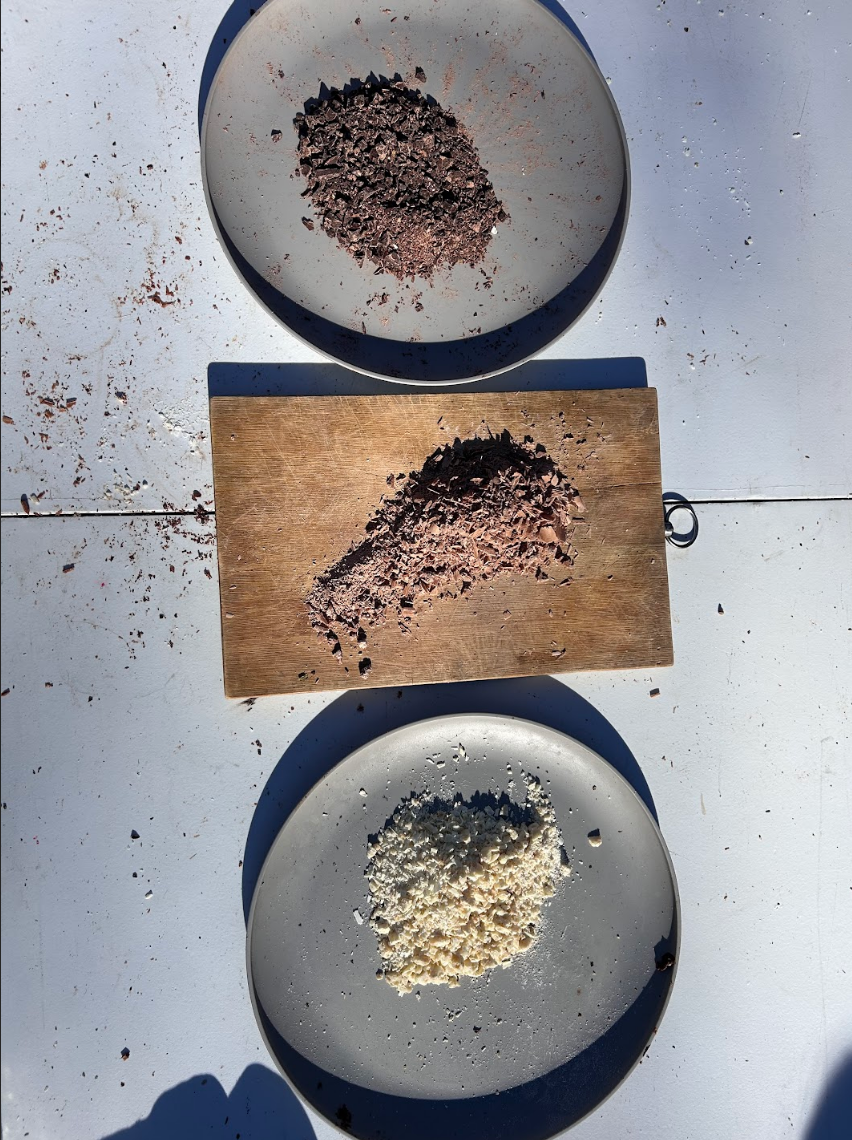
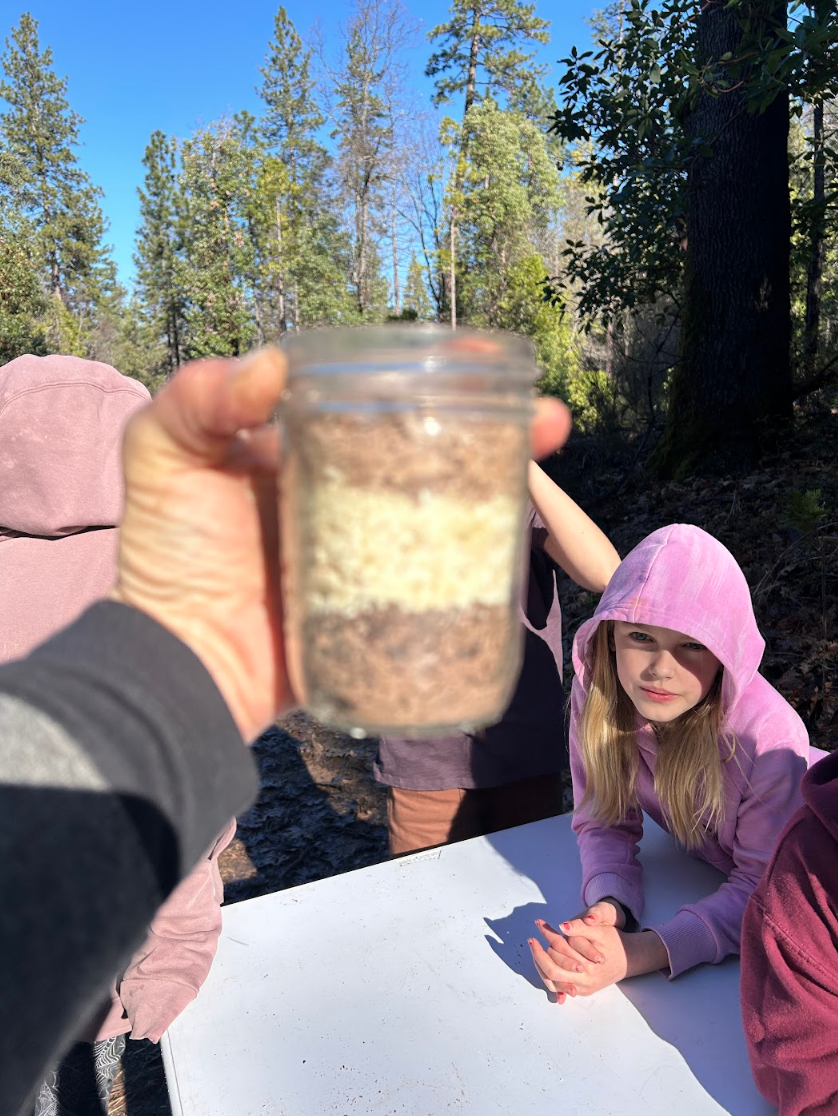
To explore sedimentary rocks, we grated white, milk, and dark chocolate into piles of “sediment.” Because it was January and quite cold, we layered the chocolate in a clear glass jar to create visible strata, similar to the Grand Canyon. Using a cup that was slightly smaller than the inside of the glass jar, the children applied pressure, compacting and cementing the layers into a “solid” rock.
To demonstrate metamorphic rocks, we gently heated the layered chocolate in a pan, watching it soften and change while still retaining some structure. This showed how heat and pressure transform rock without fully mixing and integrating the ingredients.
For igneous rocks, we increased the heat and stirred the chocolate until it melted completely, simulating magma deep within the Earth. We discussed how minerals separate and crystallize as magma cools, which is why many igneous rocks, like amethyst, are so visually striking.
And yes, after careful observation, we ate our experiment.
Movement, Games, and the Rock Cycle
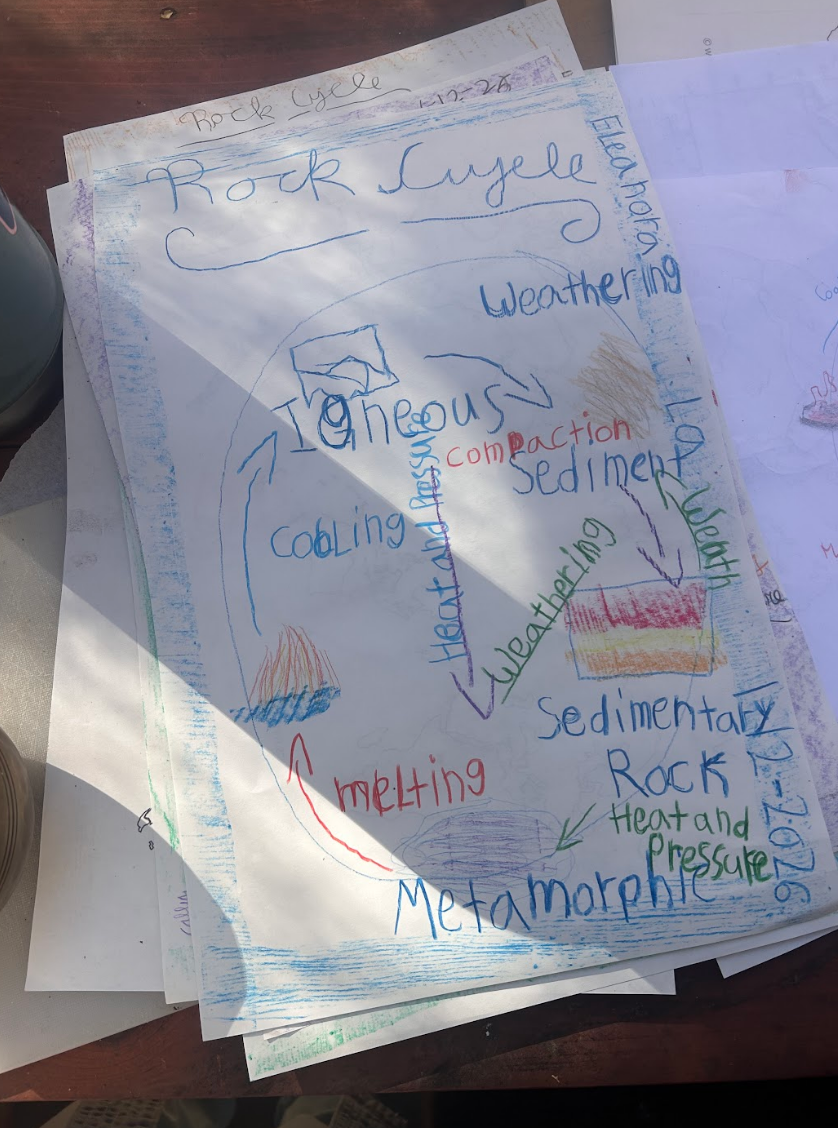
To help students integrate what they experienced, we diagrammed the rock cycle together and played movement-based games using the vocabulary igneous, sedimentary, and metamorphic.
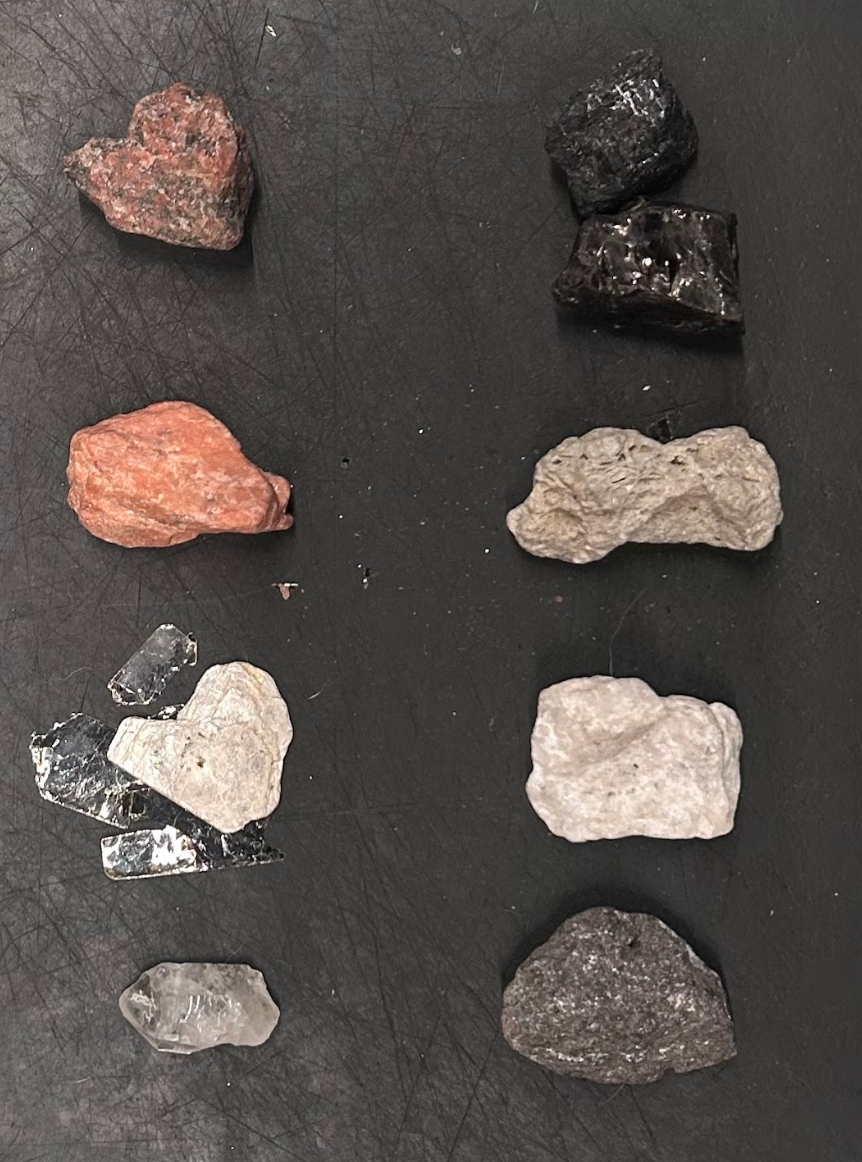
During the story and again while diagramming the rock cycle and writing a summary we use visual aids…the rocks mentioned in the story!
From bottom to top, left to right they are:
Quartz, Mica, Feldspar (those three combine to make Granite), Granite.
Basalt, Marble, Limestone, Coal
Reflection, Sleep, and Integration
We also began learning a rock cycle song in American Sign Language set to the beat of We Will Rock You.
After a full day of story, movement, games, and hands-on learning, we slept on it. Sleep plays a critical role in learning, allowing the brain to process and consolidate new information.
The following day, students wrote summaries of the story, reinforcing both earth science concepts and language arts skills such as sequencing, comprehension, and written expression.
Science Questions We Explored
What minerals make up granite, and what qualities does each mineral possess?
What kind of rock comes from animals, and how is it formed?
What kind of rock comes from plants, and how is it formed?
Imagination, observation, and hands-on work unlocked students’ understanding, in a way that feels both meaningful and foundational, of how rocks form and change over time.
When learning moves through the body, the senses, and imagination, it becomes part of a child’s inner landscape. These experiences lay a foundation for curiosity, confidence, and a lasting relationship with the natural world.