A Sneak Peek into our Volcano Study Unit: Shield, Strato, and Caldera—oh my!
From myth to eruption: exploring three powerful forces that shape the Earth.
For the past four weeks, we’ve been immersed in our volcano study unit, exploring the geologic forces that shape the land beneath our feet.
To introduce the topic, we began with an original myth about Vulcan and his three volcanic children: Shield, Strato, and Caldera. Through this story, the children were introduced to three major types of volcanoes and the different ways they form. Below is the story:
One day Vulcan called his children to him: “Caldera, Strato, Shield… come see Papa.” They all came running. He said, “Sit down, children. Let’s have a little chat.” They sat down, and Vulcan continued, “Now, you three have been watching me do my work for quite a few years now. Can you tell me what it is that I do?”
Shield piped up and said, “You make oceanic crust. You push magma up to the Earth’s surface under the ocean, and it oozes out and turns to lava and hardens as basalt.”
Vulcan said, “Wow, very nicely said. I also relieve a little of the heat and gas and pressure down here in the mantle. You know, someday I will retire, and then my job will be handed over to you. So what I’d like you three to do is show me how you would do my job… make crust and relieve the heat and pressure down here.”
The three jumped up excitedly. “Really, Papa? We can do that?”
Vulcan nodded and said, “Get to work.” The three scattered away, deep in thought.
Shield was the oldest. He looked at all the molten rock in the Earth, and he looked at how Papa made crust by pushing magma up through the plates to push them apart and make more crust under the ocean. He thought, ‘hmmmm. Papa’s magma has very little silica in it, so it is quite oozy and runny. What if I take his same magma, and rather than pushing it up to the crust where the plates meet, I push it up here in the middle of the Pacific Ocean?’
He tried that, and his magma turned to basalt lava quickly underwater, making a little mound of new Earth. He called over his brother and sister. “Hey guys, look at this. I did it!”
Strato said, “Wow… you did! Looks great, but really, it’s still underwater and not very big. Can you make it bigger?”
Shield looked at his little mound and said, “Yeah, sure. That was easy. I’ll just keep oozing lava out of the same hole. It’s bound to just keep building up, right?”
And that’s what Shield did. He just kept pushing more and more and more magma up. And the mound of lava just kept building and building and building. Since it was so soft and oozy, it spread out a lot before going up.
In fact, it is still oozing out lava in the Pacific Ocean, in a spot known as Hawaii! It is still oozing to this day. Kīlauea erupted in 1983, and lava still pours out every day. In 30 years, this volcano made over 500 acres.
The type of volcanoes that ooze very runny, low-silica lava and build up slowly, rather flat but very large, are called shield volcanoes. The land that is made is called basalt if it cools quickly so no crystals form, or gabbro if it cools more slowly and forms gorgeous greenish-black crystals.
While Shield was busy pushing up lava, Strato was busy figuring out another way to make land. He couldn’t do the same thing as his brother. He had to do something different.
So he looked at Vulcan’s and Shield’s lava and thought, “this stuff is way too runny and doesn’t build up fast enough. What if my lava is thicker and it will stick together better and not just run down the hill into the water? I bet if I mix some of my magma with granite that is filled with silica, I can make a lava that will be thick and sticky and build up quickly. Yeah, that’ll work. But how can I get my ocean crust to mix with the continental plate crust? Hmmm… I know—subduction! I will push my ocean plate toward the continental plate. When they collide, the ocean plate will be forced below the crust where it is nice and warm. It will melt under the crust, mix with some granite, and then I’ll push that new magma up through the continental crust, heating up some more of that granite until, Poooof! Thick, rich molten rock—which I’ll call andesite—will rise from the mantle and make new Earth.
It will build up nice and tall and quick… way, way taller and quicker than Shield’s slow building runny lava.”
And so that is what Strato did. It took quite a while for the ocean crust to sink and melt before Strato could start pushing. But eventually everything was ready, and he pushed and pushed and pushed.
“OMG…” he said out loud. “This stuff is so thick and so hard to push. Something must be blocking the top—like a plug or cork or something. I’ll just push harder.”
And so he pushed harder. Still nothing. So he pushed and pushed and pushed some more, working up a sweat and breathing heavy.
Finally, with one more big exhale and push… BOOOOOOM!
The Earth exploded, and all of Strato’s molten rock shot high into the sky. Some of his molten rock cooled so quickly that it became solid on the way, some became rock in the air, and some solidified as it ran out of the Earth.
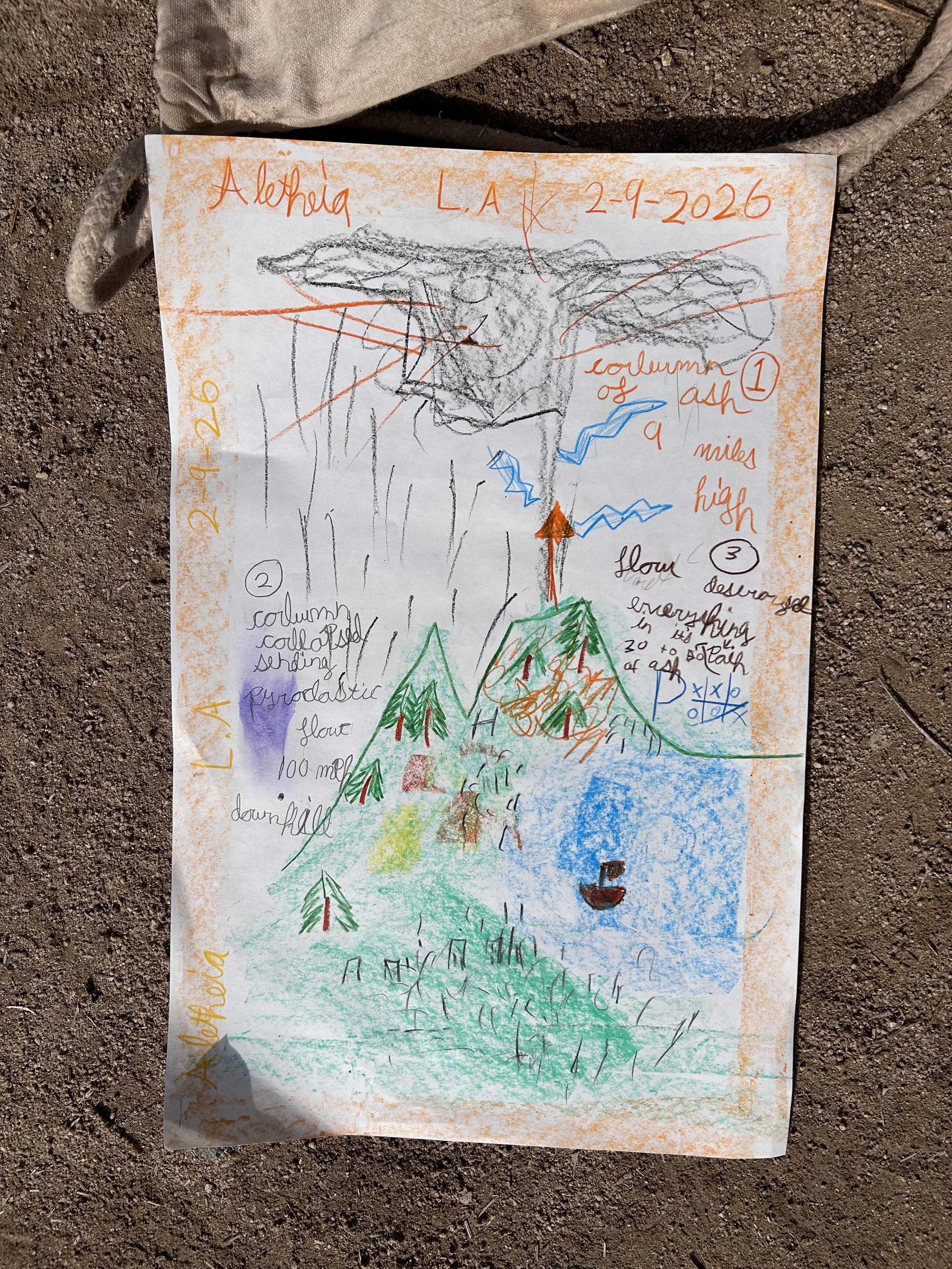
He had made so much molten rock in all those years that he had waited that when it finally erupted out of the Earth, clouds filled with rock, ash, and gases went up to 12 miles straight into the air, spread out for 19 miles, and the eruption lasted for 10 hours.
It was big. It was impressive.
Strato didn’t have to call Vulcan or Shield or Caldera—they all heard it and came running to check it out. They were pretty much speechless at first, just watching that enormous cloud and rock shoot up from the Earth and then fall back to the ground in a big, cone-shaped mountain.
Vulcan, Shield, and Caldera were very, very impressed, and so they said, “Do it again! Do it again!”
Strato was happy to do it again and again and again. He made a whole chain of these volcanoes. We call them the Cascades. They are still alive and active today. Perhaps if you ask him to “do it again,” he will. The last time he did it was in 1980 - Mount St. Helens.
So now it was little Caldera’s turn.
What could she possibly do to impress her Papa after Shield’s never-ending island-building ooze and Strato’s explosive mountain-building volcanoes?
She thought long and hard, “What should I do? What can I do? I really like how big and explosive and fast Strato built his volcano. He did that because he added more silica to his magma. What if I add even more? Won’t mine get even stickier and thicker and build even faster? And I’ll make an even bigger pile of molten rock. I’ll wait even longer so I have even more.”
As she waited for her rock to melt and thicken with silica, she had plenty of time to think of a name for it. She thought, “I think I’ll call my rock rhyolite.”
She waited some more… waiting, waiting, waiting… until one day she had about 250 cubic miles of molten rock in a big, pool-like holding tank called a magma chamber under Earth.
She thought, “I think that will do.”
And so she gave it a push.
Two hundred fifty cubic miles of molten rock does not do anything with just a ‘push’.
So she pushed harder and harder and harder. Nothing happened. She called her brothers for help. Even they could not push this magma bubble up to the crust.
Caldera ran to Vulcan. “Papa, we need your help. We are just not strong enough to push up my magma bubble. Can you help us? Besides, I think you want to see this.”
And so Vulcan, Shield, Strato, and Caldera pushed and pushed and pushed. They were breathing hard, and with each breath they mixed lots and lots of gas into the magma.
Finally, Vulcan said, “Okay, on the count of 100,000, give it the biggest push you have.”
And so they counted to 100,000, and with a great big heave-ho, they pushed.
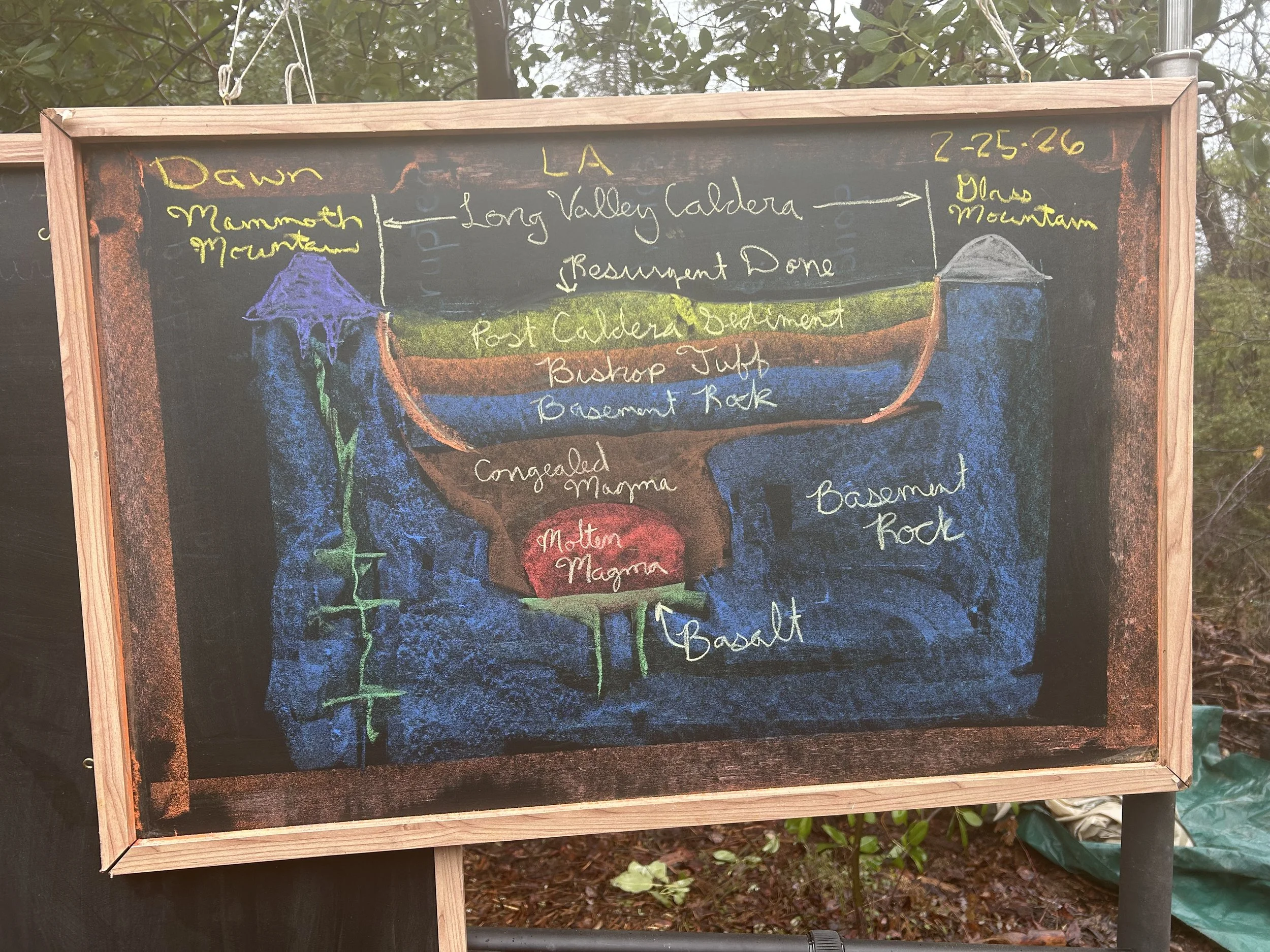
The magma bubble was so big that rather than shooting up straight up from the center like Strato’s, it shot up around the sides and sank in the middle. It made a caldera—a depression nearly as wide as the magma bubble, about 20 miles around.
The new rock Caldera had made, rhyolite, shot up around the perimeter of the caldera into the air along with lots of gas and other rocks that were already part of the crust. Ash, rock, and gas erupted into the air 25 miles (Strato’s was only 12 miles). Debris flew everywhere. It was 500 times bigger than Strato’s.
Vulcan and his children were speechless. They watched as the debris continued to fall out of the sky.
When Vulcan and the kids could finally speak, Shield and Strato said, “That was scary! Don’t do it again!”
Together, the family decided that Caldera’s volcano should be called a supervolcano.
We have remnants of a supervolcano in Eastern California—the Long Valley Caldera. Mammoth Mountain is on its 20-mile-wide perimeter. To this day, 760,000 years later, hot springs and dangerous gases abound in that area.
Despite Caldera’s frightening eruption, Vulcan was very proud of his children. He gave them all giant hugs, and they continue today to make shield volcanoes, stratovolcanoes, and—if we humans are lucky—Caldera is not planning any of her supervolcano eruptions anytime soon.
From there, our exploration moved from story into science.
Reading the Words of a Witness
To understand the power of stratovolcanoes, we turned to one of the most famous eyewitness accounts in history: Pliny the Younger’s description of the eruption of Mount Vesuvius in 79 AD, the eruption that buried Pompeii.
Listening to his words describing the towering cloud rising into the sky and ash falling like snow helped the children imagine what it might have been like to witness such an event.
We also explored the eruption of Mount St. Helens in 1980, discussing how stratovolcanoes build steep mountains through layers of lava, ash, and explosive eruptions.
Experiments in Eruption
Volcanoes are powerful to read about, but even more powerful to see in action.
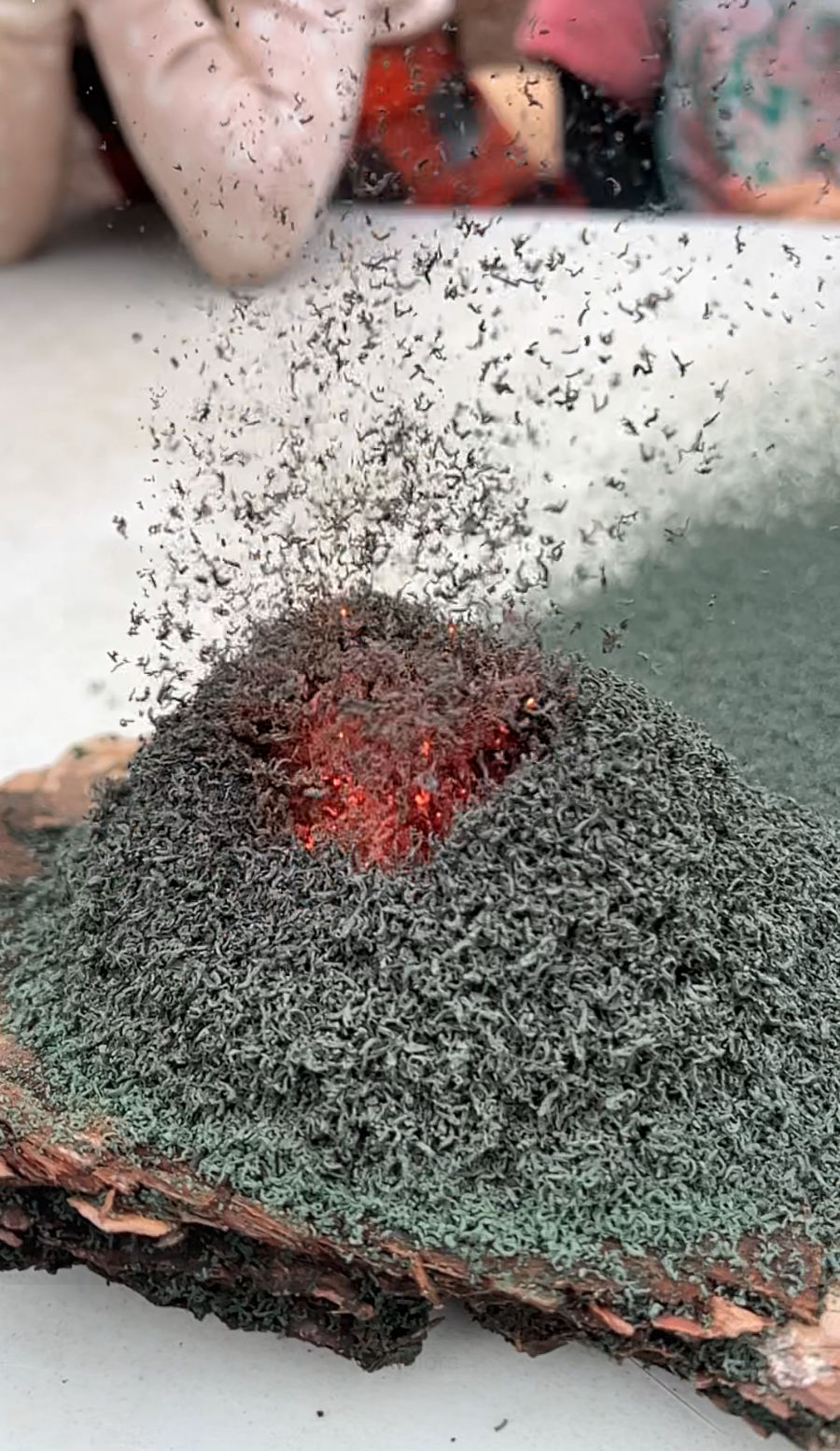
To demonstrate a stratovolcano eruption, we ignited ammonium dichromate, creating a dramatic reaction that produced ash and built a small mound of mineral “lava.” It was a vivid demonstration of how volcanic eruptions can create new land.
Slow oozing Shield Volcanoes
When it came time to explore shield volcanoes, we turned our attention to the Pacific and the volcanic islands of Hawai‘i. We shared the story of Pele, the Hawaiian goddess of volcanoes, whose fiery presence is woven into the landscape of the islands.
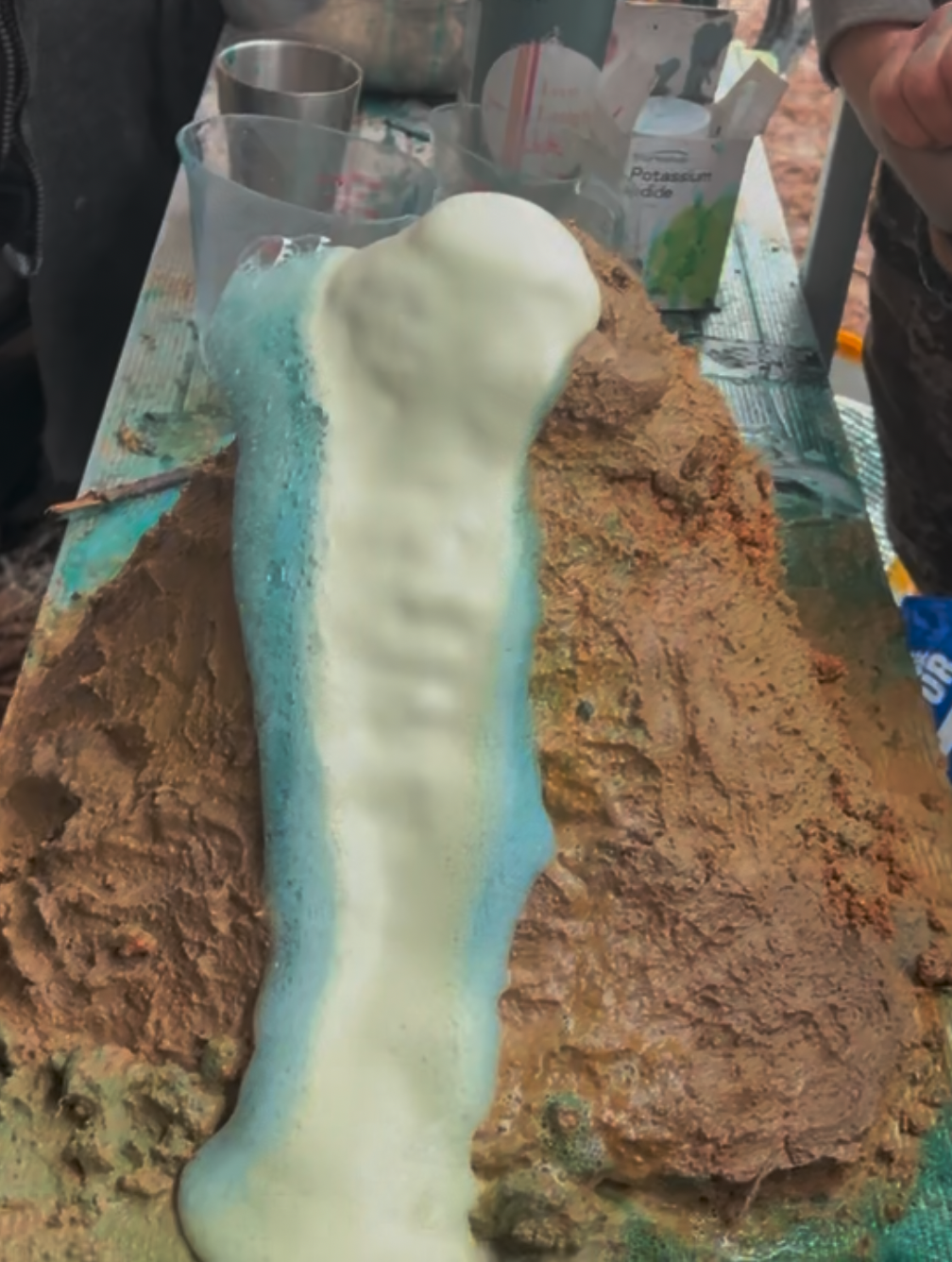
Then we built our own volcano in the mud—forming the mountain around the bottom of a bottle and triggering an eruption with hydrogen peroxide, potassium iodide, and hot water. Thick foam poured slowly down the sides, much like the flowing lava of shield volcanoes.
The Power of Supervolcanoes
Our final exploration focused on supervolcanoes.
Right here in California lies the Long Valley Caldera, near Mammoth. Around 760,000 years ago, this massive eruption released so much magma that the ground collapsed inward, leaving behind a depression nearly twenty miles wide.
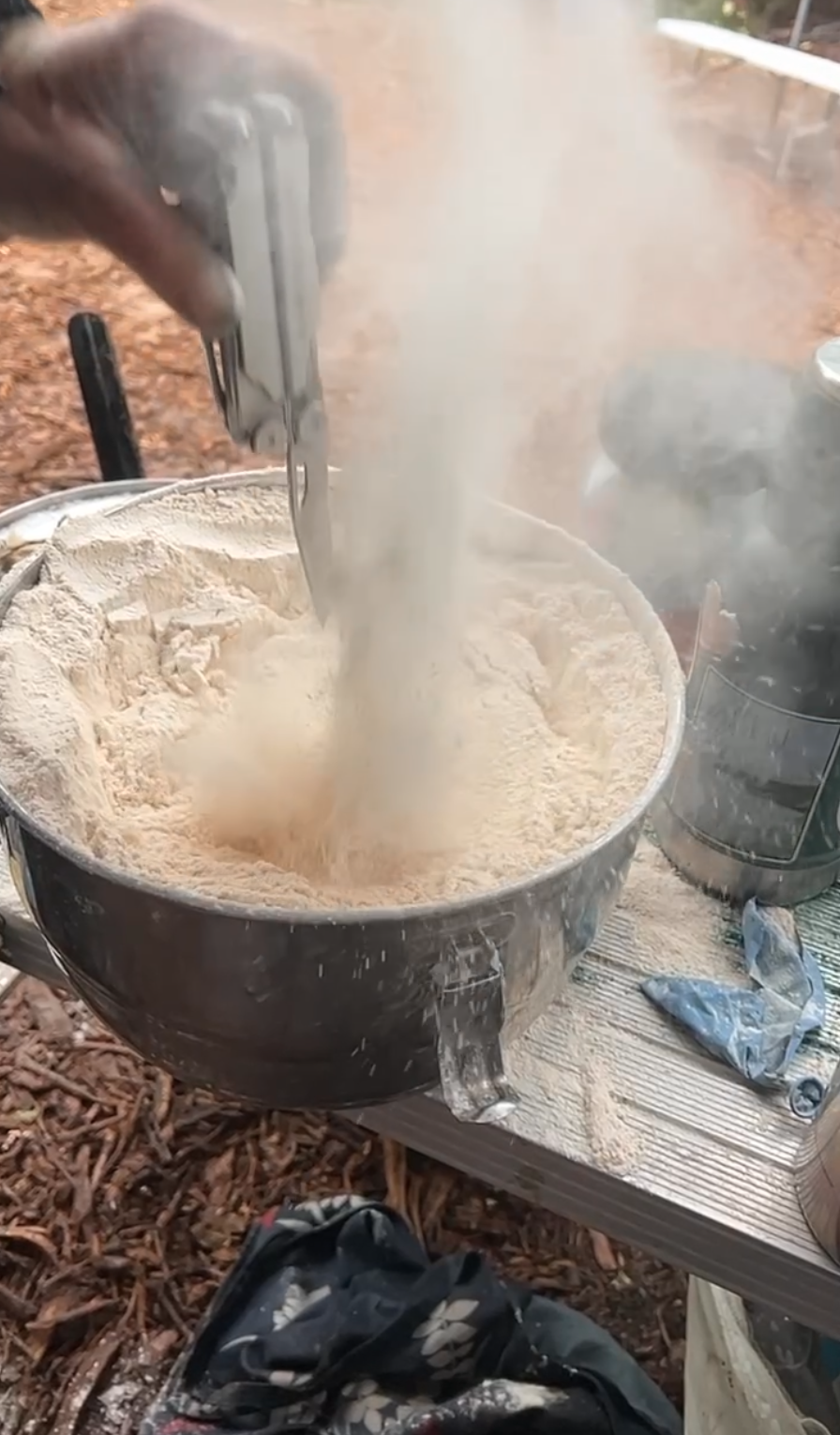
To demonstrate this process, we buried a balloon beneath a bowl of flour and popped it, allowing the surface to collapse inward and form a miniature caldera.
It was a simple experiment, but an effective way to visualize how enormous volcanic eruptions can reshape entire landscapes.
Volcanoes remind us that the Earth is not static. Beneath the surface, our planet is constantly shifting, melting, rising, and building new land.
Over four weeks, the children explored these forces through stories, historical accounts, hands-on experiments, and their own observations.
The result was a study unit filled with questions, muddy hands, fiery reactions, and a deeper appreciation for the dynamic planet we live on.